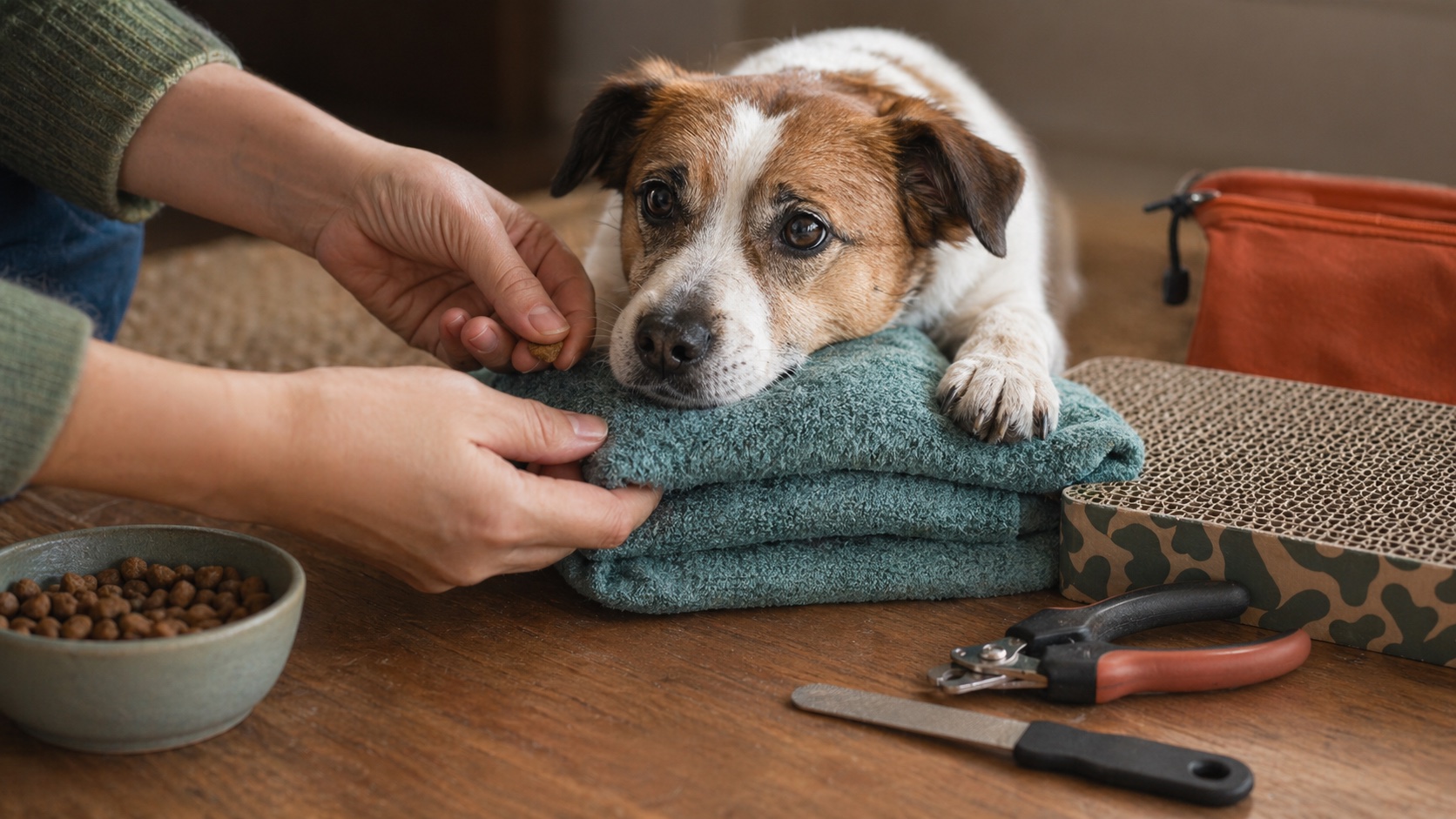
A dog who growls when you touch a paw is not being dramatic. Paw handling, nail trims, ear checks, brushing, medication, and vet exams can all feel invasive. If the only time a paw is touched is right before restraint or a clipper, the dog has good reason to worry.
Cooperative care means teaching the animal how to participate before the procedure matters. It is slower at first and faster later because you stop spending every session repairing trust.
Start with a station, not the clippers
Choose a towel, mat, low platform, or specific bed. Feed there for simply standing, sitting, or lying calmly. Do not touch paws yet. The station should predict easy rewards and the option to leave.
The VCA teaching calm guide describes a Touching Game that builds from settling into gentle body handling. That is the right order for worried dogs: calm context first, touch second, procedure much later.
Use tiny steps your dog can say yes to
A useful first goal is not "trim the nails." It is "my dog stays loose when I reach toward a shoulder." Then "my dog stays loose when I touch a front leg." Then "my dog lets my hand slide near the paw." Each step earns food and ends before the dog needs to pull away.
- Reach toward the dog, feed, stop.
- Touch shoulder, feed, stop.
- Touch leg, feed, stop.
- Touch paw for half a second, feed, stop.
- Hold paw briefly, feed, stop.
- Show clippers at a distance, feed, put them away.
This is desensitization and counterconditioning in plain language. VCA's overview explains the principle: keep exposure low enough that the pet does not become frightened, and pair that exposure with something that creates a positive response.
Let the dog opt out before they have to shout
Watch for turning away, licking lips, freezing, whale eye, paw pulling, panting, sudden sniffing, or taking treats harder than usual. Those are not annoyances. They are information. If you stop at the whisper, your dog does not need to escalate to a growl, snap, or bite.
Fear Free's nail trim guidance is a good companion for this work because it focuses on reducing fear, anxiety, and stress around paw care. For some dogs, a scratch board may be a better starting point than clippers.
Practice vet-prep behaviors outside the clinic
Handling is easier when the dog already knows the pattern. Practice lifting lips for one second, touching ears, looking at paws, gently holding a collar, stepping on a scale, and standing on a towel. Keep it brief. Pay well. Stop before the dog wants to leave.
If the vet visit itself is the hard part, VCA's guide to reducing fear of veterinary visits explains why gradual practice, calm body language, and starting at a level the dog can handle matter. Your clinic may also be willing to schedule happy visits, medication planning, or lower-stress handling notes in the chart.
When not to push through
Stop and get help if your dog has bitten during handling, panics at the sight of tools, guards their body, has painful nails or feet, or needs a medical procedure that cannot wait for training. Your veterinarian can help decide whether pain relief, sedation, medication, a grooming plan, or a behavior referral is the safest next step.