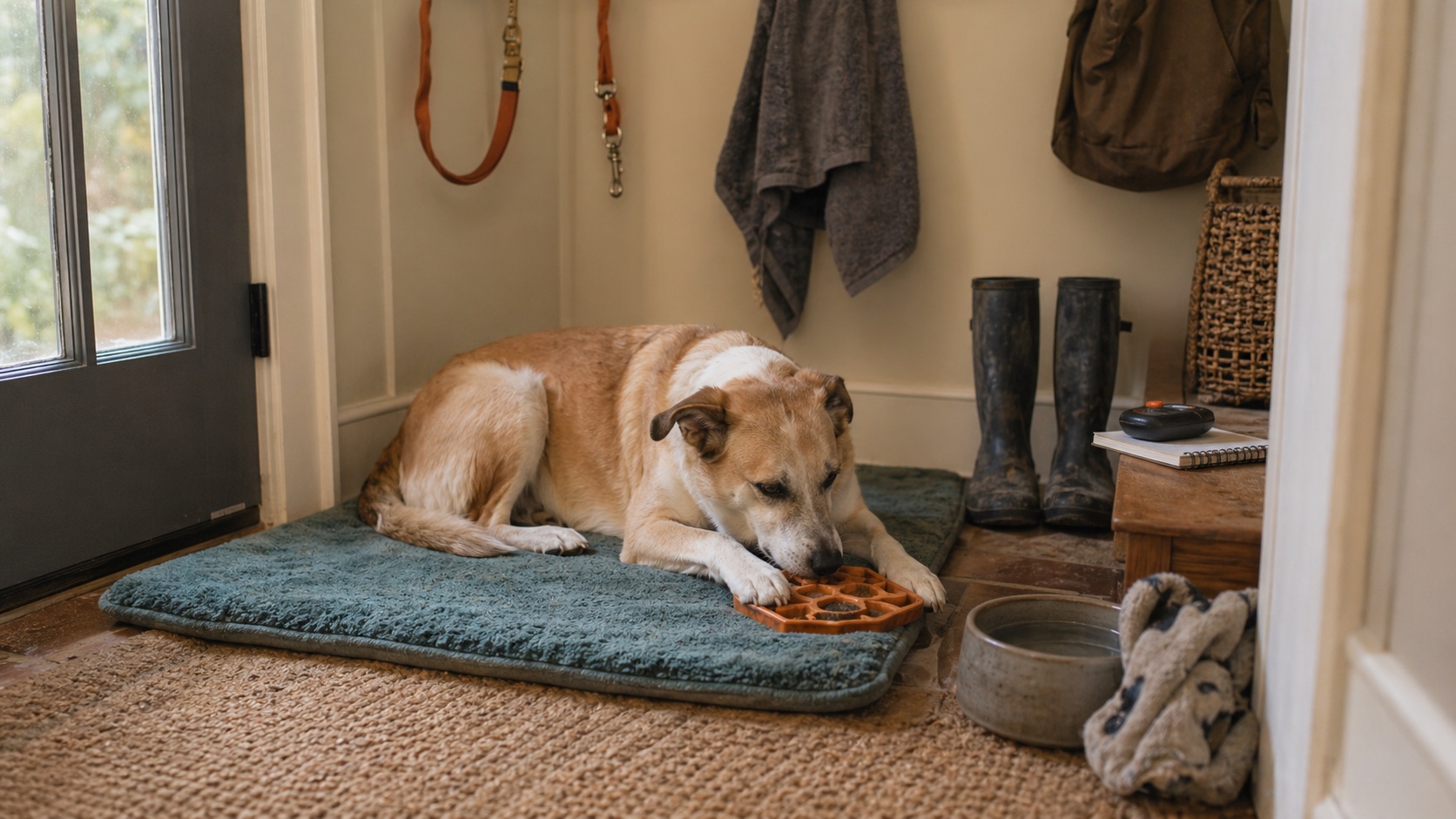
Some dogs do not move from excitement to rest smoothly. They jump after visitors leave, mouth hands after play, bark after walks, steal objects in the evening, or seem unable to stop scanning the room. People often call this stubbornness. More often, it is arousal that has nowhere useful to go.
A settle routine is not a command to be quiet. It is a pattern that helps a dog recover. The VCA teaching calm guide explains that dogs may struggle to settle when they are excited, overstimulated, overtired, fearful, distressed, bored, or physically uncomfortable. That list matters because the solution is not always "more exercise."
First, check the basics
Before building a training plan, ask whether the dog is getting enough sleep, predictable meals, pain-free movement, bathroom opportunities, and appropriate mental work. A dog who is overtired may look more frantic, not less. A dog in pain may look restless. A bored adolescent may be ready to invent a job nobody asked for.
If overarousal appears suddenly, comes with limping, appetite change, digestive upset, sound sensitivity, or handling sensitivity, check in with your veterinarian. Training cannot outwork an untreated medical problem.
Build the settle when nothing exciting is happening
Pick one mat or bed. Practice after a normal bathroom break, not after a chaotic play session. Sit nearby. When your dog steps onto the mat, quietly drop food between their front paws. When they lie down, feed again. Keep delivery low and boring. The reward should support calm, not restart the party.
Dr. Karen Overall's Protocol for Relaxation is a structured version of this idea: short, repeated exercises that help a dog practice calm behavior while tiny distractions change around them. It is not a race. If the dog gets worried or activated, back up.
Use a landing strip after hard moments
Many households need a recovery plan for predictable events: visitors, walks, training class, vet trips, playdates, or grooming. A landing strip is a prepared sequence that tells the dog what happens next.
- Water and a bathroom break if needed.
- Five to ten minutes of quiet sniffing, licking, chewing, or food puzzle work.
- A mat or bed in a low-traffic space.
- Low voice, low movement, and no wrestling or chase games while the dog is coming down.
For dogs who mouth or nip when excited, the ASPCA's guide to mouthing and play biting is useful because it separates normal play mouthing from behavior that may come from fear or frustration. If the mouth gets hard, the body gets stiff, or someone is unsafe, get professional help.
Reward recovery, not just obedience
It is tempting to ask for sits, downs, and stays until the dog looks under control. Sometimes that helps. Sometimes the dog is physically still but internally boiling. Watch for softer signals: breathing slows, eyes blink, muscles loosen, the dog can sniff, the dog can take food gently, the dog can disengage from you and rest.
This is where desensitization and counterconditioning matter. If a trigger always sends the dog into chaos, lower the trigger intensity and pair easier versions with things the dog enjoys. Do not keep practicing at the level where the dog falls apart.
When to ask for help
Ask your veterinarian or a qualified behavior professional for help if your dog cannot sleep, injures people while aroused, redirects onto another pet, panics when confined, or gets worse despite more management. The American College of Veterinary Behaviorists is a good starting point when anxiety, medication, pain, or safety questions may be part of the case.