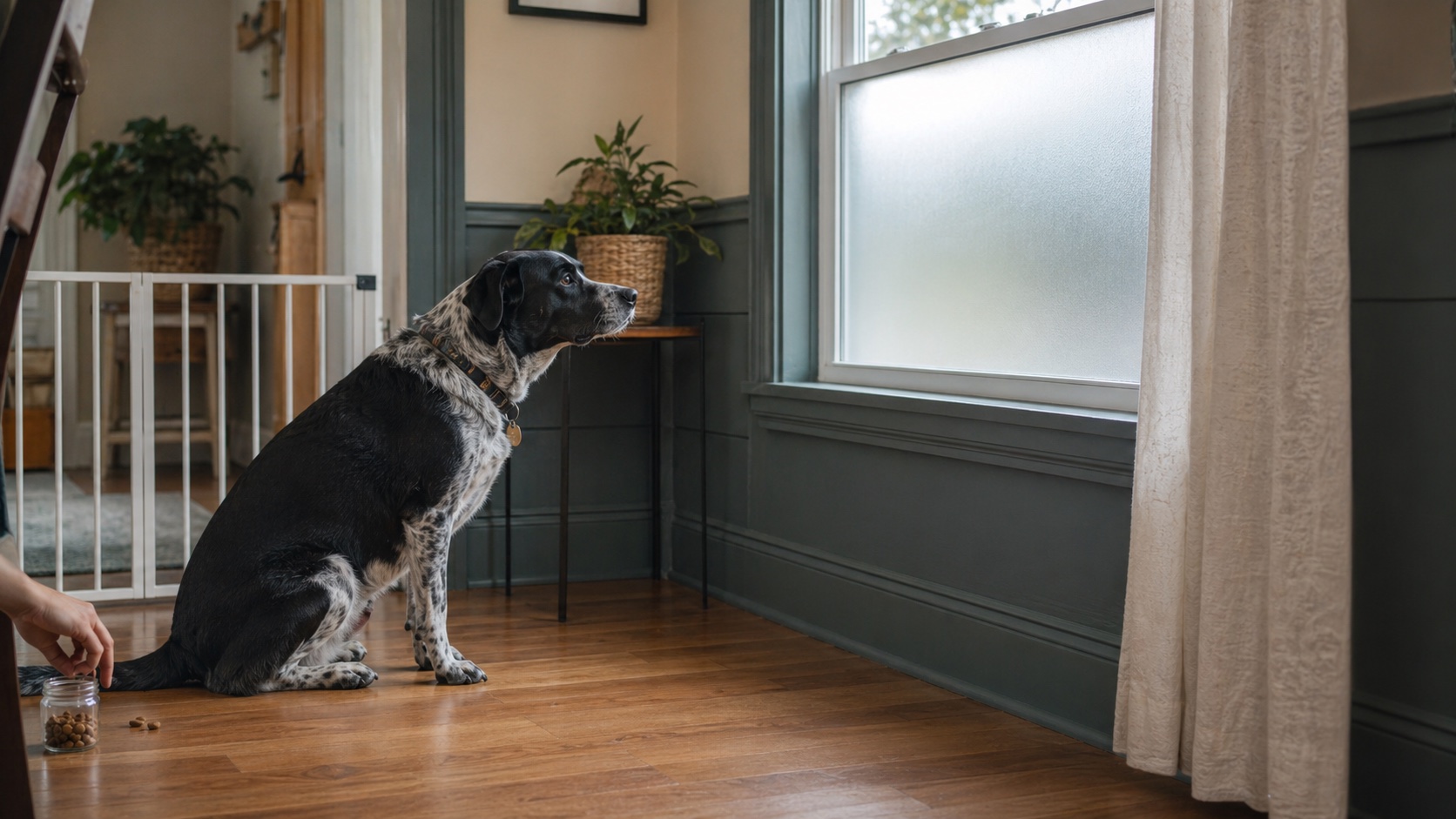
Window barking is easy to misunderstand because it looks like disobedience. Your dog sees a person, dog, delivery truck, school bus, or squirrel pass the house, rushes the glass, barks, and then the trigger leaves. From the dog's point of view, barking may appear to work. The thing moved away.
The ASPCA's barking guide makes the first important point: barking has different functions. Some dogs bark from alarm or territorial concern. Some bark from frustration. Some bark because the window has become their best entertainment. The plan gets better when you know which pattern you are seeing.
Step one: stop giving the window so much practice
This is management, not failure. If the dog rehearses the full routine twenty times a day, every training session has to compete with twenty free repetitions. Start by lowering the difficulty.
- Use frosted window film, curtains, or furniture placement to block the most triggering view.
- Move resting spots a few feet away from the window instead of placing beds directly at the lookout point.
- Use gates or closed doors during predictable busy times, such as school pickup or delivery windows.
- Play quiet sound, a fan, or white noise if hallway or street noise starts the barking before the dog even sees anything.
The ASPCA specifically recommends limiting the dog's ability to see people and animals outside when territorial or alarm barking is the problem. That is not avoiding training. It is reducing the number of times your dog practices the exact behavior you want to change.
Step two: teach a place away from the glass
Pick a mat, bed, or rug several feet from the window. Start when nothing is happening outside. Drop a treat on the mat when your dog steps on it. Feed there when your dog lies down. Keep your voice low and your body quiet.
The VCA guide to teaching settle and calm is useful here because it treats settling as a learned skill. You are not asking your dog to magically relax in the hardest moment. You are building a default place where calm behavior pays before the hard moment arrives.
Step three: pay the first look, not the tenth bark
Once the mat has value, watch for the earliest sign that your dog noticed something outside: ears forward, head lift, stillness, one quiet look. Say a simple marker like "yes" and drop a treat on the mat. If your dog can eat and return attention to you, the setup is probably workable.
If your dog cannot eat, runs to the glass, or explodes immediately, the setup is too hard. Close the curtain, increase distance, or practice at a quieter time. VCA's introduction to desensitization and counterconditioning explains why intensity matters: exposure should start low enough that the pet does not tip into a full fear or arousal response.
What not to do
Yelling often joins the barking instead of ending it. Punishing alarmed or fearful barking can also make the dog feel worse about the trigger, even if it briefly interrupts the sound. If your dog is barking from fear, anxiety, or territorial concern, the AVSAB humane training statements are a good reminder that behavior modification should focus on changing the animal's emotional response, not just suppressing warning signs.
A simple two-week plan
- Days 1-3: block the view and feed meals or treats on the mat away from the window.
- Days 4-7: reward quiet looks toward mild outdoor movement before barking starts.
- Days 8-10: add a cue such as "mat" when your dog is already moving toward the spot.
- Days 11-14: practice during slightly busier times, but keep the view partially blocked.
If your dog cannot recover after triggers, redirects onto people or other pets, or seems panicked by ordinary neighborhood movement, bring in a qualified professional. The CCPDT guide to choosing a trainer can help you screen for humane, evidence-aware help.